
How to Be a Hero
Nothing is too terrifying if you understand it

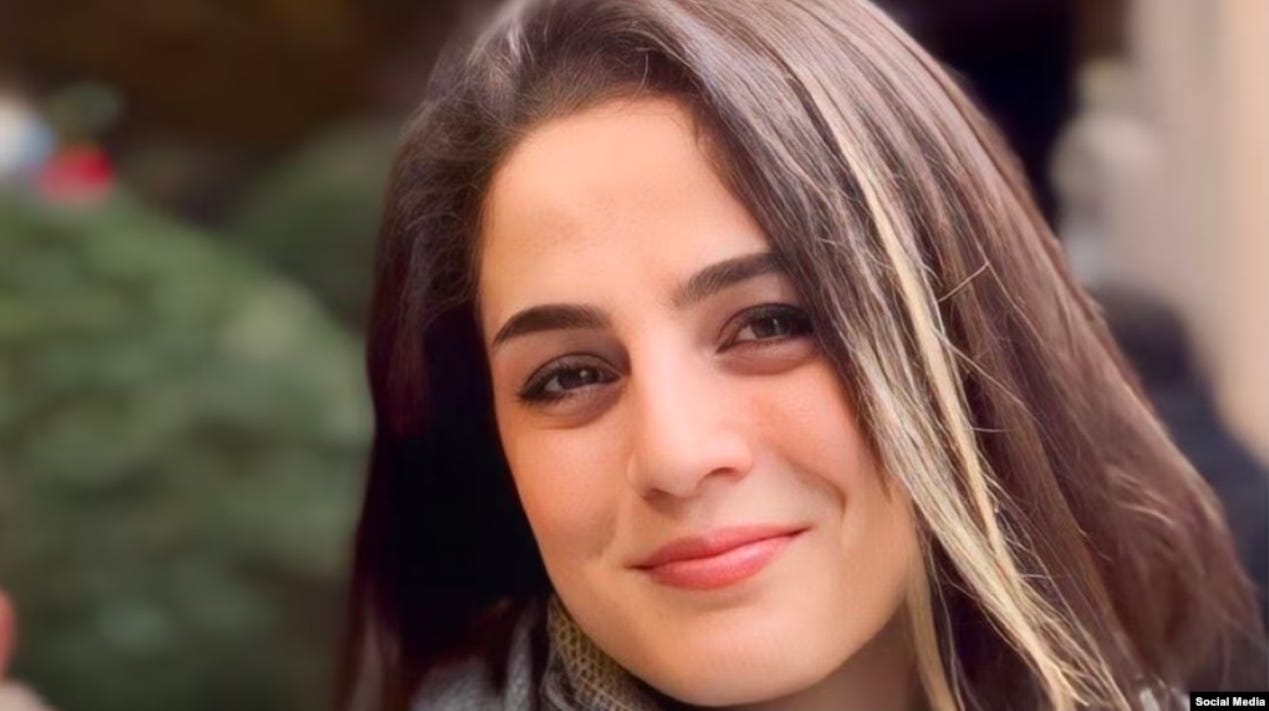
The following story was published on BBC Persian under the title “Roya Heshmati: the story of whips on a woman who walked with a skirt and a red shirt.” Translated by me:
“An Iranian woman's account of being flogged for defying mandatory hijab laws has sparked widespread reactions.
Maziar Tataei, Roya Heshmati’s lawyer, told Shargh newspaper that she was “arrested on May 1st, officers broke into her home at night, confiscated her cell phone and laptop, and put her in detention for 11 days.”
According to this lawyer, Ms. Heshmati was sentenced to 13 years and 9 months in prison, a fine of 11.25 million tomans, and 148 lashes in Branch 1091 of the Guidance Judicial Complex. However, after she appealed the verdict, the sentence was commuted to a fine of 1.25 million tomans, and 74 lashes.
Roya Heshmati’s account of being flogged has been circulated many times after being republished by Sepideh Rashno, a writer opposed to compulsory hijab.
According to Roya Heshmati, security officers have insisted on her wearing a headscarf while flogging her, but she continues to refuse to accept the forced hijab and, while enduring the flogging, sings one of the anthems of the “Women, Life, Freedom” movement.
Many have praised Ms. Heshmati’s courage. The flogging punishment for wearing the desired clothing has sparked outrage.
Roya Heshmati shared her story alongside a photo of Sarina Esmaeilzadeh, a teenage girl who voiced her social concerns and had a YouTube channel. Sarina was killed during the 2023 protests.
Mizan, the news agency of Iran's judiciary, confirmed the conviction and execution of Roya Heshmati's flogging sentence, calling it “in accordance with the law” and wrote that Ms. Heshmati “attempted to influence the atmosphere during the execution of the sentence by engaging in inappropriate behavior.”
Iran’s Judiciary News Agency said Ms. Heshmati was walking “on the streets of Tehran in a very disgusting condition.”
The news agency also said that she had “ties with an organized foreign group and received payments to promote pornography at specific times in high-traffic streets.”
Accusations of receiving money from abroad in exchange for appearing on the streets without a hijab have been repeated many times without any documentation from the Islamic Republic authorities. It is unclear who is paying these alleged payments and how.”
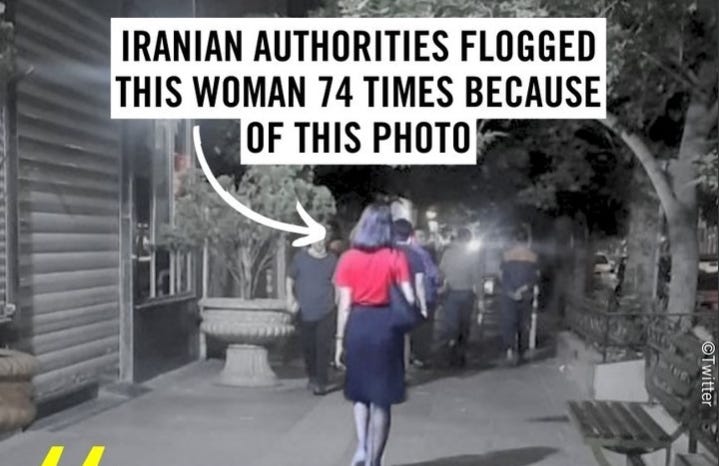
Roya Heshmati’s story: We will continue our resistance
“This morning I received a call from the Execution Department about the enforcement of my sentence of 74 lashes. I called my lawyer and we went together to the 7th District Prosecutor’s Office.
As we passed through the entrance gate, I took off my hijab. We entered the hall. The sound of a woman screaming and wailing came from the stairs as they were dragging her down. Maybe they were taking her to carry out a sentence...
“Roya, think again. The effects of the whip will stay with you for a long time,” my lawyer told me.
We went to Branch 1 of the Enforcement. The branch employee told me to put my headscarf on so I wouldn’t get into trouble. I told him calmly and respectfully that that’s why I came here to get whipped; I won’t put it on.
They called and an enforcement officer came up. He said, “Put your hijab on and follow me.” I said, “I won’t.” He said, “You won’t?! I’ll whip you so hard you’ll learn where you belong. I’ll open a new criminal case for you, and you can be our guest for another seventy-four [lashes].”
I still didn’t put it on.
We went downstairs. They had brought some boys [to be whipped] for drinking alcohol. The man repeated firmly, “Didn’t I tell you to cover your head?!” I didn’t [cover myself]. Two veiled women came and pulled the veil over my head. I took it off again and this was repeated several times. They handcuffed me from behind and pulled the veil over my head.
We went down the same stairs that that woman had been taken to, to the basement floor. It was a small room at the end of the parking lot. The judge, the executioner, and a veiled woman were standing next to me. The woman was clearly affected. She sighed a few times and said, “I know. I know.”
The judge laughed at me. I remember the blind, pig-headed, owl-eyed man. I turned my face away from him.
They opened the iron door. The walls of the room were made of concrete. There was a bed at the end of the room with iron handcuffs and shackles welded to both sides. There was an iron device that looked like a large canvas stand with rusty iron handcuffs and shackles in the middle of the room, and a chair and a small table behind the door, on which lied an assortment of whips.
It was a full-fledged medieval torture chamber.
The judge asked, “Madam, are you okay?” I reacted as if he didn’t exist. He said, “Madam, I’m talking to you!” I still didn’t answer. The man in charge of executing the sentence said, “Take off your coat and lie down on the bed.” I hung my coat and scarf on the torture rack. He said, “Put your scarf on!” I said, “No. Go ahead. Put your Quran under your arm and start whipping.” And I lay down on the bed. The veiled woman came and said, “Please don’t be stubborn.” She brought the scarf and pulled it over my head.
The man picked up a black leather whip from the bunch of whips behind the door, wrapped it around his hand twice, and came to the bed.
The judge said, “don’t hit too hard.” The man started hitting me. My shoulders. My back. My hips. My thighs. My calves. I lost count of the number of hits.
I was singing under my breath, “In the name of woman, in the name of life, The veil of slavery is torn. Soon our black night will break into dawn, And all whips will be axed and gone....”
It was over. We came out. I didn’t let them think I was even hurt. They are too despicable and small [to see me hurt]. We went up to the judge executing the sentence. The female officer was walking behind me, making sure that my headscarf didn’t fall off. At the door of the branch, I threw my headscarf off. The woman said, “Please, cover your head.” I didn’t, and she pulled it back on my head again. In the judge’s room, the judge said that “we ourselves are not happy about this, but it’s the sentence and it must be carried out.” I didn’t answer him. He said, “if you want to live differently, you can leave and go abroad.” I said “this country is for everyone.” He said “yes, but the law must be respected.” I said, “let the law do what it does. We will continue our resistance.”
We came out of the room, and I took off my headscarf.
This story is so remarkable that it belongs in history books alongside Frederick Douglass’s Narrative and Anne Frank’s diary.
What surprised me the most about her story is how calm and unaffected she was. Growing up in Iran, I witnessed countless women (including my own friends) get arrested for not wearing their hijab. They would burst into gut-wrenching cries and pleas. Sometimes they were taken to detention, sometimes let go with a warning. Always left traumatized, and rarely ever went public with their story— understandably so.
But Roya Heshmati is different. She was not only arrested but also flogged for not wearing a hijab—a horror that would have irrevocably broken many others. Yet, she emerged unbroken. She went public with her story, and her account is not that of someone left helplessly traumatized. That is not how one typically recounts a tragedy. She reminds me of how I talk about my story. Not as a tragedy, but a triumph.
What is the source of her strength? What made her so resilient in the face of this colossal injustice?
In my experience, the most insidious part of being a victim is the hidden guilt you carry for your own victimization. Enduring a flogging (or, in my instance, rape) is terrifying and painful. But the deepest, most enduring pain—the pain that lingers even after your scars have faded—is the nagging voice in your head that tells you: it was all your fault. You were the unreasonable one.
This occurs even if you despise your victimizers. My friend resented the regime, but when she was arrested by the morality police, she told herself: “It’s my fault. I’ve been selfish. I should have just covered my head. They are monsters, but deep down, they are right—it is the law, after all.”
If that was what Roya Heshmati had told herself, she would have felt the pain and shamefully hidden it from the world. By going public, she demonstrated that she knew she was in the right—that she stood on the side of life, and that the regime agents were wrong, relying on an illegitimate law to oppress their victims.
In my own experience, the scariest moments of being under the total dominion of a rapist in Europe were the moments I believed he was right—that I was a guest in his country and had to obey his rules. He wanted me to believe that it was not rape, but a transaction in exchange for his assistance with my visa. A transaction I had voluntarily entered and could walk away from. The implication being: if I didn’t want to return to Iran, I must have wanted everything he was doing to me.
The terror diminished significantly once I understood the situation first-handedly. I spent weeks questioning, learning, and reasoning until I understood that, in a deep sense, my wounds were not self-inflicted. They were the result of a deeply immoral immigration regime that forces peaceful, young, idealistic people to go to extreme lengths and make bargains with rapists and traffickers in order to survive.
I still remember the day I reached that moral clarity. That was the day I became invincible. Whatever he took away from me, he couldn’t take my self-esteem. Even his most vile acts couldn’t break my spirit anymore. That was the day I started making plans to escape, which ultimately led me to America.
Just as my abuser constructed a castle of justifications, totalitarian regimes like Iran invoke ‘law,’ ‘authority,’ and ‘justice’ to rationalize their exploitation. They don’t need us to agree with them—they only need us to think that what they are doing is understandable, legitimate, and justified.
As a victim (and generally, as a good person), we must not rely on the narrative of our oppressors. Our first and foremost duty is to form our own ruthlessly honest account of what happened—a narrative that allows us to trace where we may have made mistakes, but also to stand firmly where we did the right thing.
That is the difference between a coward, a helplessly traumatized victim, and an unbroken hero—a Roya Heshmati.
If I could interview Roya, this is what I imagine she’d say: “They couldn’t scare me; I see them too clearly.”